
🪶 Make the distinction
- Rookery
- A breeding colony
- Resting flock
- Birds gathered at rest; nesting is not established by the gathering
- Uncertain view
- Describe the activity you can see
- Photo on this page
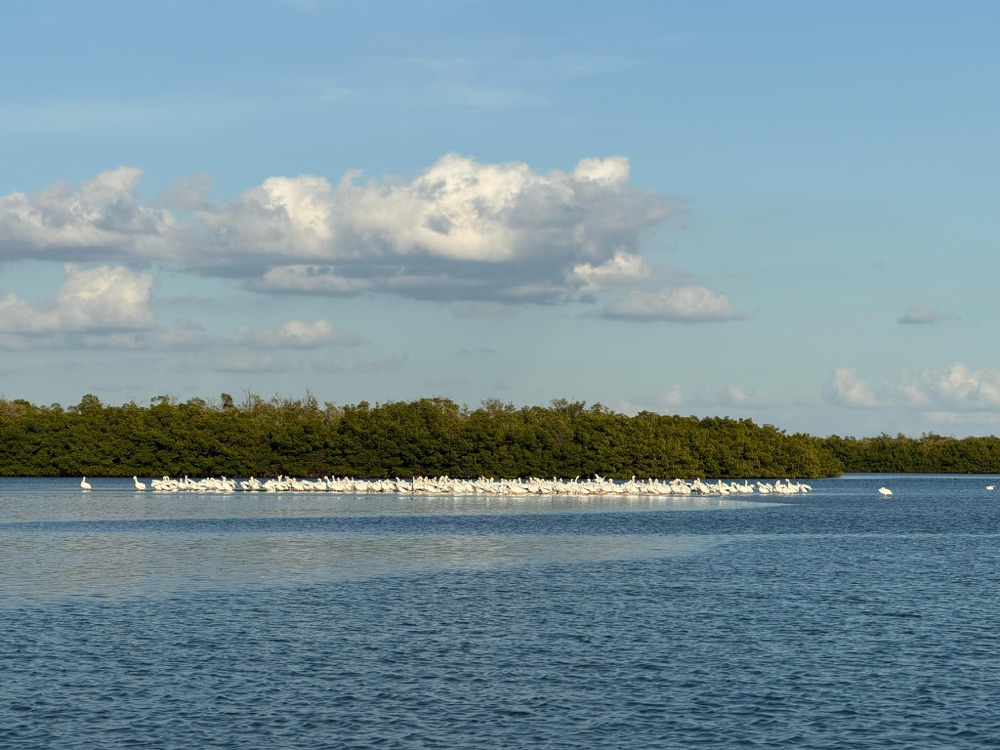
- Resting white pelicans; no visible evidence of a nesting colony
What makes a group of birds a rookery?
A rookery is about breeding, rather than simply the number of birds in view. Florida's waterbirds include species that nest in colonies, in trees or on the ground. The FWC bird-disturbance guide describes those different nesting settings and why disturbance matters. A visitor does not need to identify a nest before giving a gathering of birds space.
Use a modest description when the view is limited: birds resting on a bar, birds feeding in shallow water, or a group in the trees. Those are useful observations in their own right. Keep the site description separate from a claim about its breeding status. It also helps when you compare your notes with someone who watched a different part of the flock.
Describe what you can actually see
Think of the table as a vocabulary aid, with a boundary on each interpretation. You can record a behavior without deciding every reason behind it. The wildlife checklist gives you a simple place to keep the observation and its confidence together.
| Visible activity | A useful note | What it does not settle |
|---|---|---|
| Birds standing together on a bar | A resting group, if resting is what you observe | Whether the site contains nests |
| Birds taking food along the edge | A feeding group | Where those birds breed |
| A nest visible from your existing viewpoint | A possible nesting observation, with the detail recorded | The size or status of a whole colony |
| Birds too distant for detail | An unidentified group | Species, nest contents or breeding stage |
A distance guideline does not open a closed area
FWC gives at least 500 feet as a rule of thumb for keeping away from concentrations of birds. It also advises avoiding nesting colonies during nesting season and honoring posted closures. These parts belong together: the distance guideline is not permission to approach a colony or cross a closed boundary. FWC explains that flushing nesting adults can expose young and eggs to predators and temperature extremes.
The agency's separate beach-nesting bird guidance tells visitors to stay out of posted shorebird and seabird areas. A short visit, quiet voices or a camera do not change that advice. Keep any trip question about where viewing is possible with the operator; this page supplies no navigation or landing instructions.
What can a photograph establish?
The lead photograph here shows white pelicans resting on a low bar. It does not show nests or chicks, so it cannot document a rookery, a nesting season or a future tour encounter. Apply the same care to your own captions. A close crop can remove the surroundings that would help another reader understand the scene, and a species name does not establish that the bird was breeding.
Ask about the outing, with room for a different day
A seasonal guide can explain an ecological interest, while an actual trip listing tells you what you are booking. Ask about the available outing for your dates and describe a birding interest as a request. Do not assume a named nesting island, an engine-off drift or a photography arrangement is included. Call (239) 301-8913 before choosing among the current trip options. The caption exercise below helps you describe the birds you do observe.
From the Helm: Write a bird-group caption that the photograph can support
Begin a bird-group caption with the visible scene. A long line on a bar, birds in the branches or a flock feeding along the edge gives a reader something concrete to picture. You can then add an identification when you have enough detail. Leave the reason for the gathering open when you cannot establish it. A photograph can be memorable without becoming evidence for a nesting claim that neither the image nor your observation supports.
The lead image is a useful exercise. It contains white pelicans resting together, water in front and mangroves behind. No nests or chicks are visible. A caption describing the resting group fits those pixels. A caption calling it a breeding colony, naming a precise nesting stage or saying every visitor will see the same gathering would add a story the photograph cannot establish. The distinction matters even when the image appears beside a page about rookeries.
Keep the wider frame when it helps explain the setting. A tight crop can make distant birds seem close and remove the water between them and the observer. That does not make cropping wrong; it means the finished image may need a simpler caption. You can say what species you can identify and what activity you observed without implying a close approach, a landing on the bar or a special arrangement by a boat operator.
Dates need the same care. The date you took a picture belongs to that observation. It does not establish an annual colony schedule or the status of a site on a later visit. If you do not know when a photograph was taken, avoid using it to label a season. Similarly, a place name supplied by someone else is information to check before putting it into a confident public caption. A broad setting can be enough when a more precise location remains uncertain.
For a shared family album, separate the event from the interpretation. A hypothetical caption might read, “Birds resting together during our afternoon outing; species uncertain.” Another person's closer view might later resolve the identification, but the resting behavior and the date remain the things you observed. You can add that later information with a clear explanation of where it came from instead of rewriting the original note as though everyone knew it at the time.
Use the observation record to keep those details together. If you are planning another outing, the seasonal overview can help you frame a new question. The photograph already has a useful job: helping you remember and describe a scene. It does not need to prove a rookery visit, a breeding event or a repeatable tour result to be worth keeping.