
📋 Your field record
- Start with
- Animal group and a visible feature
- Add
- What it was doing and when you saw it
- Keep separate
- Observed, uncertain and not observed
- Trip planning
- Confirm the actual outing and departure before booking
Start with a short list you can actually use
Rookery Bay Reserve's wildlife inventory includes bottlenose dolphins, manatees, sea turtles and many birds, including brown pelicans, great blue herons, roseate spoonbills and ospreys. That is a habitat inventory across a large reserve with several environments. It is useful background for Naples and Marco Island visitors, with a different purpose from a report of sightings on your booked trip.
Choose three or four entries that interest your group. You might start with a bird on the water, a bird along the shoreline and an animal surfacing. Broad categories leave room for discovery. If everyone is trying to complete a long list, a brief view of an unfamiliar animal can turn into a hurried naming contest.
What should go beside each sighting?
Use the same few fields each time. A sentence is enough; a photograph is optional. The table below is a blank record structure, with example details to look for. It contains no promised sightings or measured probabilities.
| Field | What to write | Why it helps later |
|---|---|---|
| Animal group | Bird, mammal, reptile or uncertain | Gives you a useful starting point |
| Visible feature | Bill shape, overall color, fin or shell | Preserves the detail behind a possible name |
| Behavior | Resting, feeding, swimming or flying | Records something beyond a check mark |
| Confidence | Confirmed, possible or unidentified | Keeps a short glimpse from becoming a firm claim |
Add the date and approximate time if you want to compare your notes afterward. Describe the setting in ordinary words, such as open water or a mangrove edge. You do not need to assign a precise place name you did not know at the time. The rookery and resting-flock guide helps with one common distinction: seeing a group of birds does not by itself establish that they are nesting.
Keep uncertain sightings useful
Write the feature before settling on the species. If a distant shape surfaced once, record that limited view. A companion may have seen a different angle; compare the details while keeping each person's observation distinct. A blurred photograph can be worth keeping as a question, even when it cannot settle the answer.
Use a separate mark for an animal you hoped to see but did not observe. That tells you about your outing, not whether the species is absent from the region. Likewise, a photograph taken on another date cannot tell you what will appear tomorrow. Our seasonal wildlife guide explains how to use ecological timing without turning it into a forecast.
Bring your interests to the booking conversation
Before choosing a trip, decide whether your group would enjoy a broad look at the water even if a favorite animal stays out of view. Ask which actual trip, departure and duration are available for your dates, and explain any birding or photography interest as a request. A checklist does not reserve an itinerary, a wildlife stop or time at a sighting. Call (239) 301-8913 with those questions and compare the current trip choices in the booking flow. The field-note example below gives your group a simple way to begin.
From the Helm: Turn a brief family sighting into a useful field note
Give each person one small job if your group wants to keep a shared record: someone notices the animal's outline, someone watches its movement, and someone writes down the time. Nobody needs to produce a name immediately. It can be more rewarding to compare three details than to have the quickest guess become the answer everyone repeats. Keep looking from the place you are already observing; filling a notebook is not a reason to seek a closer encounter.
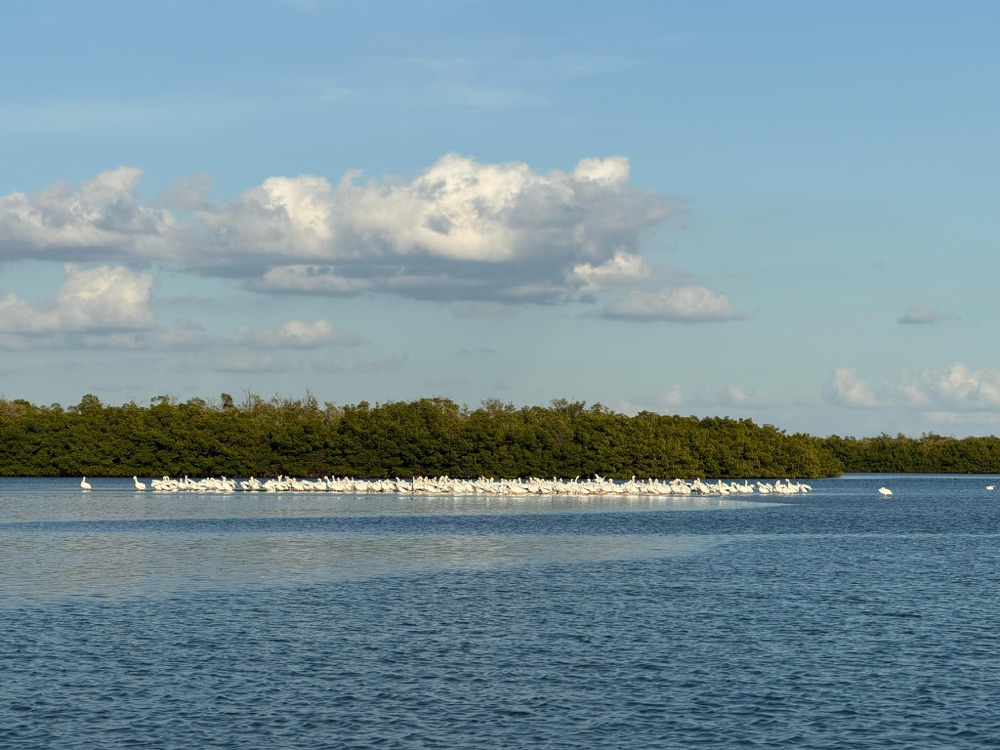
Here is a hypothetical entry, not a report from a Sand Dollar trip: “Several pale birds stood together on a low bar at about ten in the morning. One bird opened its wings. I could not see the bills clearly.” That note preserves a group size, setting, behavior and limitation. “Pelican nesting colony” would require information the entry does not contain. You can add a possible identification later without erasing the original description or the reason it was uncertain.
Use a second line for the question you want to resolve. In this example it might be whether the birds had the shape of pelicans, or whether anyone saw a bill clearly enough to help. Ask a companion what they saw before showing them a suggested answer. If you have a photograph, inspect it afterward at a comfortable size. Sometimes the image adds detail; sometimes it only confirms that the view was distant. Both results make the record more honest.
A family record can also keep separate entries for the same moment. One person may have watched the wings while another watched a bird at the water's edge. Preserve those perspectives instead of combining them into a single confident story. With children, an accurate drawing of a shape or a sentence about movement is a perfectly useful contribution. There is no need to turn the outing into a test or make every blank on the list feel like something missed.
After the outing, choose a few observations worth returning to. Add a name only when the evidence supports it, leave the rest as open questions, and keep hoped-for animals in their own part of the record. A list that includes uncertainty is easier to learn from than a full page of guesses. The rookery guide can help with the behavior description, while the seasonal guide provides context without supplying a missing identification.
If you share a caption, carry the same limits into it. “Birds resting on a bar during our outing” is enough when that is what you know. You can remember the moment warmly without giving it an exact species, nesting status or location that your notes never established.